The Life and Legacy of Vilhjalmur Stefansson: Visionary of the Friendly Arctic
The Visionary Arctic Explorer Who Redefined the North
Few figures in polar history have been as influential—or as controversial—as Vilhjalmur Stefansson, the Canadian-born Arctic explorer whose bold expeditions in the early 20th century reshaped global understandings of northern geography, culture, and survival. A man of immense curiosity and conviction, Stefansson spent years living among the Inuit, led daring voyages across the top of the world, and championed ideas about the Arctic that challenged conventional wisdom.

Photo: Vilhjalmur Stefansson Sorce: www.harvardsquarelibrary.org
Today, Stefansson stands as one of the most fascinating characters in the annals of exploration. His legacy is a complex blend of scientific achievement, anthropological insight, bold innovation, and enduring debate. This article explores Stefansson’s life, achievements, theories, and impact.
Early Life and Education
Vilhjalmur Stefansson was born on November 3, 1879, in Manitoba, Canada, to Icelandic immigrant parents who later moved to North Dakota. Raised in a farming community, Stefansson’s early life instilled in him a practical resilience and a deep appreciation for self-sufficiency—traits that would serve him well in his future explorations.
Stefansson attended the University of North Dakota before transferring to Harvard University, where he studied anthropology. His academic background shaped his later approach to exploration: he was not merely an adventurer seeking glory but a scholar driven by a desire to understand the peoples, environments, and ecosystems of the Far North.
Introduction to the Arctic: Early Expeditions
Stefansson’s first true experience with the Arctic came in 1906–1907 when he was hired as an anthropologist on the Anglo-American Polar Expedition, a joint scientific venture. Immersed in the harsh northern landscapes for the first time, he developed a fascination that would define the rest of his life.
In 1908, he joined the University of Alberta Expedition alongside zoologist Rudolph Anderson. This journey allowed Stefansson to study Inuit communities in the Mackenzie Delta and Coronation Gulf regions. His time living closely with the Inuit profoundly shaped his understanding of northern survival, human adaptability, and the Arctic as a potentially habitable environment rather than an unrelenting wasteland.
The “Friendly Arctic” Philosophy
Stefansson’s most influential and controversial idea was his belief in what he termed the “Friendly Arctic.” Unlike many explorers who viewed the far north as a desolate, hostile environment, Stefansson argued that the Arctic was a region of abundance—if one knew how to live like the people who had thrived there for centuries.
Key Principles of the “Friendly Arctic” Concept
- Adaptation to local knowledge: Stefansson believed that Inuit methods of hunting, traveling, and building shelters offered the most efficient ways to survive the harsh climate.
- Meat-based diet: He famously adopted a nearly all-meat diet similar to that of Inuit hunters, later publishing work on the nutritional viability of such a lifestyle.
- Mobility: Stefansson emphasized lightweight equipment, reliance on local food sources, and flexible travel strategies.
- Respect for indigenous expertise: He repeatedly cited Inuit skills as superior to many Western survival techniques.
His 1921 book, The Friendly Arctic, outlined this philosophy and helped cement his reputation as both a bold thinker and a polarizing figure.
The Canadian Arctic Expedition (1913–1918)
Stefansson’s most ambitious—and most controversial—venture was the Canadian Arctic Expedition, one of the largest and most complex exploration missions in Canadian history.

Source: wilkinstheadventurer
Goals of the Expedition
- Map previously uncharted islands
- Conduct scientific research in geology, anthropology, and biology
- Assert Canadian sovereignty in the Arctic Archipelago
Achievements
Despite major challenges, Stefansson’s expedition achieved several important milestones:
- Discovered new islands, including Brock, Meighen, and several smaller landmasses
- Conducted extensive ethnographic research
- Collected valuable geological, zoological, and botanical data
- Helped map the western Canadian Arctic more accurately than ever before
Controversies
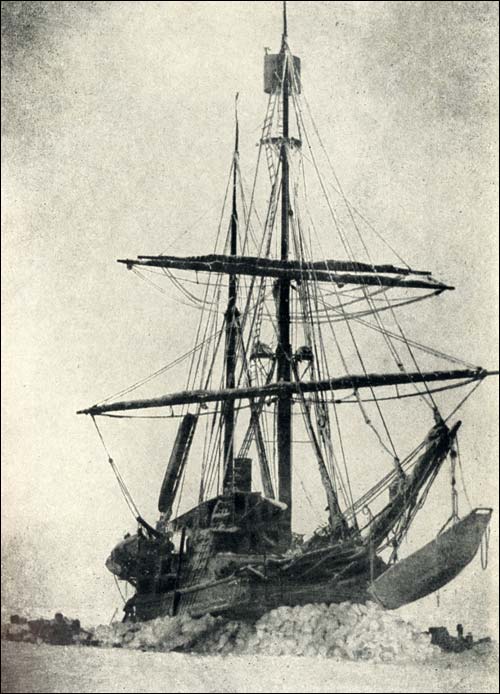
The expedition was plagued by tragedy, including the sinking of the Karluk, one of the expedition’s ships, which resulted in the deaths of eleven crew members. Stefansson left the ship early in the mission to hunt caribou, a decision that critics later called irresponsible. Admirers, however, argue that Stefansson could not have foreseen the disaster and that his departure aligned with his responsibilities as expedition leader.

Photo: The Karluk Source: heritage.nf.ca
Regardless of perspective, the Karluk tragedy remains one of the most disputed episodes in Stefansson’s career.
Ethnographic Contributions
As an anthropologist, Stefansson made lasting contributions to the study of Arctic cultures. His work with Inuit communities emphasized:
- The richness of their technological innovations
- Their deep understanding of environmental patterns
- Their adaptability and resilience
Stefansson documented traditional hunting methods, family structures, social norms, and material culture. His writings challenged many Western misconceptions about Arctic life, portraying Inuit societies as highly skilled, sophisticated, and well-adapted—not primitive or isolated.
Dietary Research and the All-Meat Diet
Perhaps one of the most unusual aspects of Stefansson’s legacy lies in his promotion of the meat-only diet, inspired by Inuit nutritional practices. Stefansson and fellow explorer Karsten Anderson voluntarily participated in a year-long medical study in 1928–1929 at Bellevue Hospital in New York, where they consumed nothing but meat and fat.
The study concluded that the diet caused no negative health effects and was nutritionally adequate. Stefansson used these findings to argue that fat-rich animal diets could sustain human health, long before modern debates about ketogenic and carnivore diets.
Though controversial, Stefansson’s dietary research remains a point of interest for nutritionists today.
Later Life and Influence
In his later years, Stefansson continued writing, lecturing, and advising governments on Arctic policy. He became a prominent advocate for northern development, arguing that the Arctic could become a thriving region with the right infrastructure and mindset.
Stefansson died in 1962, leaving behind a vast legacy of books, research papers, maps, and ethnographic records.
Legacy and Modern Perspectives
Today, Stefansson’s legacy is both celebrated and debated.
Positive Contributions
- Mapped previously unknown regions of the Arctic
- Advanced understanding of Inuit culture
- Championed indigenous knowledge
- Generated vast scientific data through decades of fieldwork
- Influenced nutrition science
- Advocated for the Arctic as a place of opportunity rather than fear
Controversies and Criticisms
- Accusations of recklessness during the Karluk disaster
- Disputes over his interpretations of Inuit culture
- Skepticism about his “Friendly Arctic” philosophy
Despite these debates, historians widely acknowledge Stefansson as one of the most significant Arctic explorers of all time.
Why Stefansson Still Matters Today
Stefansson’s work has regained relevance in an era marked by:
- Climate change
- Arctic geopolitics
- Indigenous rights movements
- Renewed interest in high-fat, low-carb diets
His ideas about adaptation, sustainability, and respect for indigenous knowledge continue to resonate in modern discussions about the North.
Conclusion
Vilhjalmur Stefansson was far more than an explorer. He was a visionary thinker who challenged assumptions about one of the most extreme environments on Earth. His belief in the “Friendly Arctic,” his embrace of Inuit knowledge, and his groundbreaking expeditions left a profound mark on anthropology, nutrition science, and polar exploration.
Though controversies surround parts of his career, his contributions remain indispensable to understanding the Arctic and its peoples. A century after his greatest expeditions, Stefansson’s impact on science, culture, and exploration is as compelling as ever.
More Info:
ARCTIC DREAMER: The Lonely Quest of Viljhalmur Stefansson
Vilhjalmur Stefansson the Arctic explorer (1957)
Stefansson’s lost children
Stefansson Arctic Institute (SAI)
This content was prepared with the assistance of AI.